English
 Hindi
Hindi
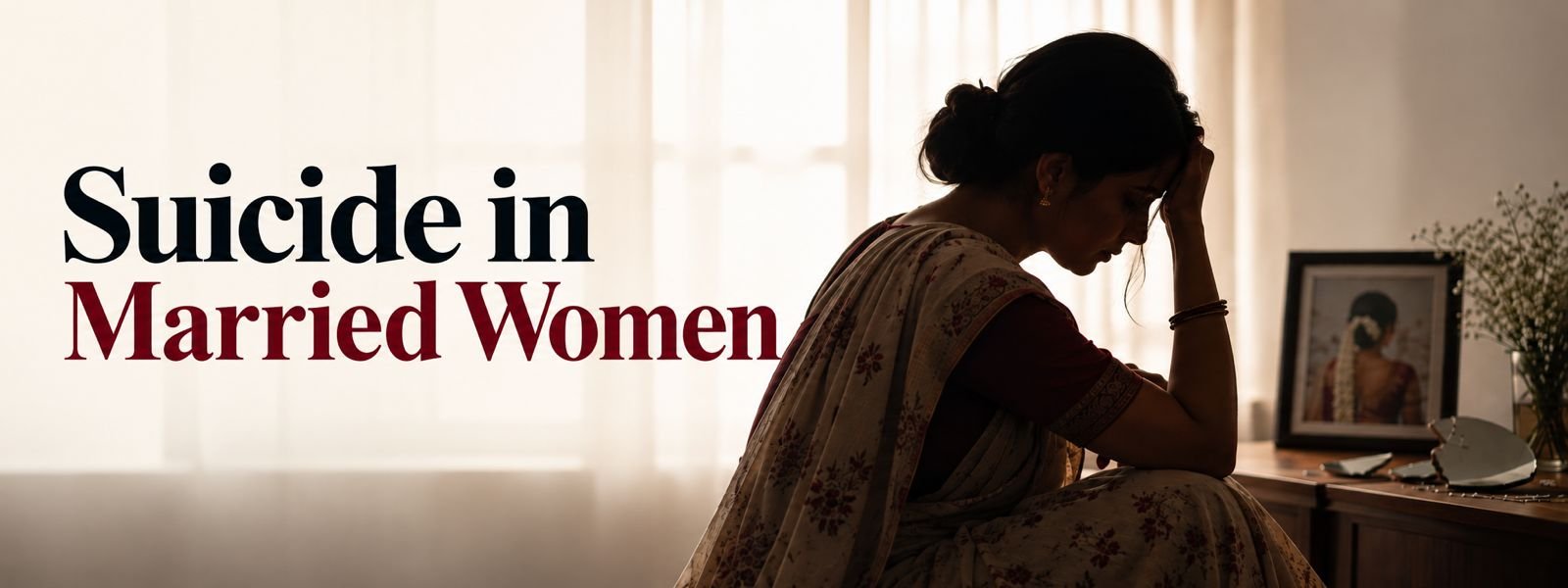
Suicide ranks first as the cause of death for women
between the ages of 15-39, which is also the time when they usually enter
abusive and/or conservative marriages. Two recent reports, when superimposed,
paint a dismal picture of the mental health landscape in India, especially
women’s mental health.
More Indian women suffer from depression and anxiety
disorders than men, and women with depression commit suicide more often than
men with depression, according to a first-of-its-kind study, published in
Lancet Psychiatry, which quantifies the burden of mental disorders in India.
Additionally, housewives accounted for the second–highest percentage of all
suicide victims in India in 2018, after daily-wage labourers, according to the
latest National Crime Records Bureau (NCRB) report. That is, 17.1% of all
suicide victims were housewives and more than half of all women suicide victims
were housewives.
The Lancet report further makes clear the positive
association between depression and suicide — a stronger link for Indian women
than for men and a pattern repeatedly found in several studies. This is when
the NCRB report’s details on the most common causes of suicides in 2018 become
important: While ‘family problems’ topped the list, women committed suicide
significantly more often due also to marriage and family issues and
dowry-related issues. The Lancet report also found that one in seven Indians
suffer from mental disorders with depressive and anxiety disorders being the
most common ones, affecting nine crore people, combined.
When seen together, the gist is this: crores of Indian
housewives are likely suffering from depression, and, if numbers are anything
to go by, thousands are being increasingly driven to end their lives because of
a manageable — and in some cases curable — disorder.
Nothing can be done about the fact that women
are biologically more predisposed to certain kinds of depressive disorders,
such as postpartum depression. However, the social factors — such as intimate
partner violence and dowry — that are contributing to women’s, especially
housewives’, depression, and in turn, pushing them to suicide, are entirely
within our control to eradicate as a society.
“Many women face arranged marriages by force. They have
dreams and aspirations, but they often do not get supportive spouses. Sometimes
their parents don’t support them either. They are trapped in a difficult system
and social milieu,” Dr. Vikram Patel, professor at the Department of Global
Health and Population, Harvard TH Chan School of Public Health, told the BBC.
“The resulting lack of romantic, trusting and affectionate relationship with
your spouse can lead to such tragedies.” 31% of married Indian women get worse
in poor, debilitating relationships — they face some form of physical and/or
sexual violence from their spouses, which is often accompanied by verbal,
psychological, and/or financial abuse from spouses and/or in-laws. This has a
direct relationship with major depressive disorder, depressive symptoms,
postpartum depression, and post-traumatic stress disorder. To top it all off,
the stigma of “log kya kahenge” around mental health keeps women more than men
from seeking help.
Before
marriage, young males generally show higher rates of completed suicide and
externalising risk behaviours, while females benefit from stronger peer-support
networks and protective social structures. After marriage, however, women in
many patriarchal or traditional contexts face a sharp increase in psychological
distress due to abrupt lifestyle changes, loss of autonomy, and heavy domestic
burdens.
Before
Marriage: Lower Vulnerability of Suicide in Females
Social
Connections: Young women tend to cultivate close, emotionally expressive
friendships that act as a buffer against stress.
Help-Seeking
Behaviours: Females are statistically more likely to talk about emotional
struggles and seek professional or social support early.
Externalising
vs. Internalising: Young men before marriage often engage in higher-risk
externalising behaviours (such as substance abuse or reckless conduct), which
elevate baseline injury and
mortality rates.
After Marriage: Increased Vulnerability of Suicide in Females
Role Disruption and Expectations: Marriage often requires
a woman to leave her familiar support system (family and friends) and shoulder
disproportionate domestic and caregiving duties.
Loss of Autonomy: Restrictive social norms, financial
dependence, and isolation in new households can trigger chronic anxiety and
depression.
Interpersonal Conflict: Stresses related to in-laws,
domestic disagreements, and spousal discord heavily impact women who
internalise emotional pain.
Abuse and Safety: Domestic violence or coercion within an
unsupportive marital environment significantly heightens severe depressive
symptoms and suicide risk.